Trending Insights

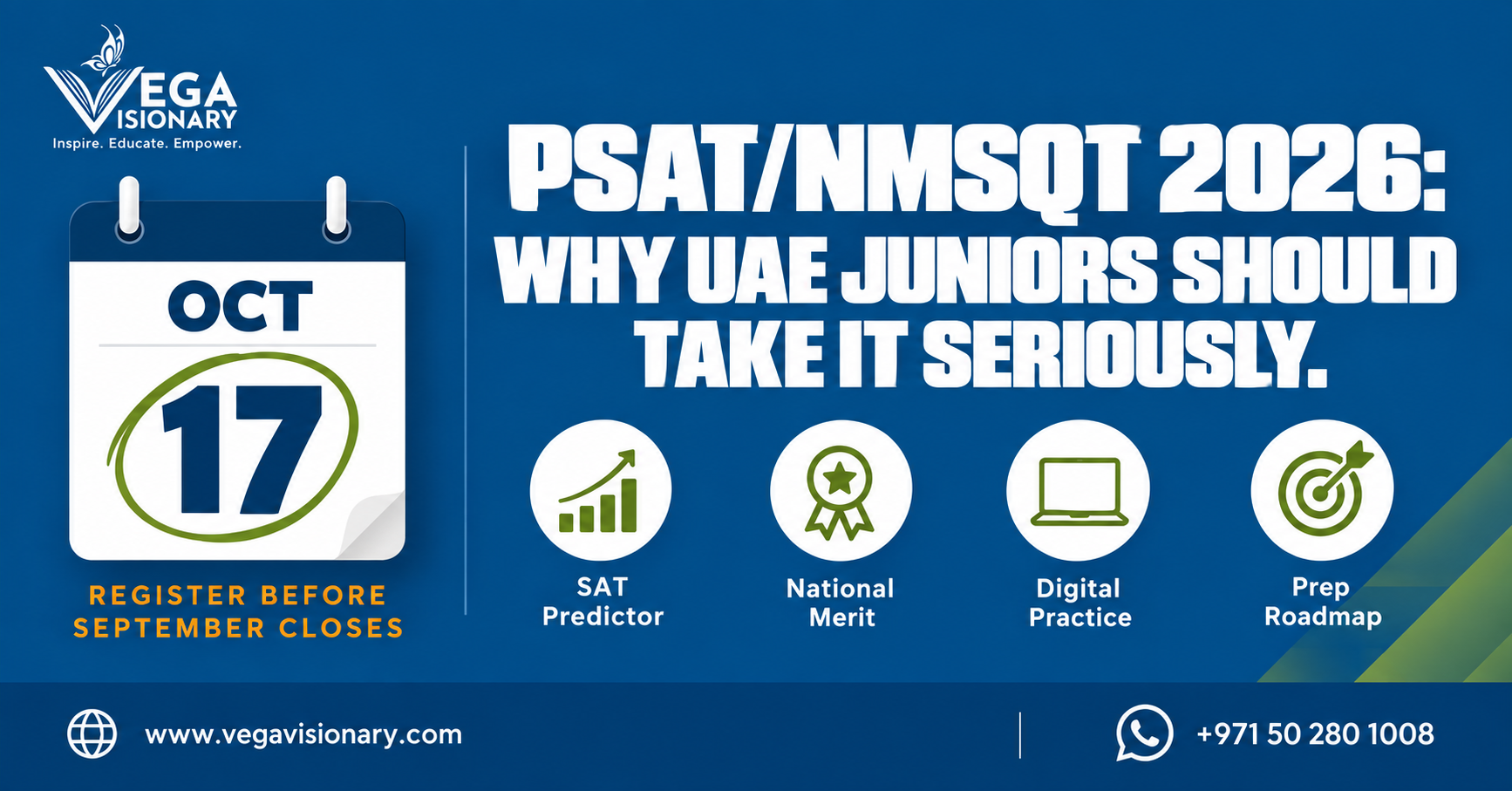
The PSAT/NMSQT sits on 17 October 2026, and many schools across the UAE are finalising their registration lists through September. If you are a junior and you have not yet confirmed with your school counselor that your name is on that list, this is the moment to check, because for many students, this single test in October carries more weight than its “practice” name suggests.
The PSAT/NMSQT, short for the Preliminary SAT and National Merit Scholarship Qualifying Test, is administered by the College Board in a digital format during a testing window that runs from 1 to 31 October each year. Individual schools choose the exact date within that window, and for the 2026 cycle, a number of American and international curriculum schools in the UAE have scheduled their sitting for 17 October. The test itself runs approximately 2 hours and 14 minutes, split into a Reading and Writing section and a Math section, both of which are section level adaptive, meaning the difficulty of the second module adjusts based on how a student performs in the first.
1. It Is the Most Accurate Predictor of Your SAT Score
Because the PSAT/NMSQT uses the same digital, adaptive format and scoring scale as the SAT, it functions as the single most reliable early indicator of how a student is likely to perform on the actual SAT. Treating it as a low-stakes formality wastes an opportunity to get an honest, data-backed read on strengths and gaps well before senior year application pressure sets in.
2. It Is the Entry Point for National Merit Recognition
Junior-year PSAT/NMSQT scores are what the National Merit Scholarship Corporation uses to identify Semifinalists, Commended Students, and eventually Finalists, a distinction earned by roughly the top slice of scorers nationally. Eligibility rules apply differently depending on citizenship and schooling location, so UAE students attending high school outside the United States should check the specific citizenship requirements that apply to students testing abroad, since not every student qualifies for National Merit consideration in the same way a student testing inside the US does. Even where National Merit eligibility does not apply, the test still holds full value as SAT practice and diagnostic data.
3. It Builds Real Digital Exam Experience Before It Counts
For students who have not yet sat a College Board digital test, the PSAT/NMSQT is a genuine dry run, complete with the same interface, timing structure, and on-screen tools used on test day for the SAT. Walking into the actual SAT already familiar with that environment removes one major source of first-time nerves.
4. It Shapes How Junior Year Prep Time Gets Spent
A detailed PSAT/NMSQT score report breaks performance down by section and skill area, which turns junior year SAT preparation from a generic study plan into a targeted one. Students walk away knowing exactly where to focus in the months leading into their SAT sitting, rather than guessing.
Get a diagnostic review of your PSAT or practice test results and a personalised prep roadmap from our SAT specialists, built around your actual score report, not a generic study plan.
Schools are managing PSAT/NMSQT registration internally through September, which means the responsibility to confirm a spot sits with the student and family, not just the school. With the window closing this month, there is a short list of things worth confirming now rather than in October.
The digital PSAT/NMSQT is delivered through the College Board’s Bluebook testing application, the same platform used for the digital SAT, so students who have already explored Bluebook will find the interface familiar. The Reading and Writing section comes first, followed by the Math section, with a short break in between. Calculators are permitted throughout the Math section, either a personal approved calculator or the built-in graphing calculator inside the testing application.
The PSAT/NMSQT is easy to treat as an afterthought sandwiched between the start of junior year and the real weight of SAT season, but the data it produces and the door it opens toward National Merit recognition make it worth taking seriously from the outset. If your school’s September registration deadline is approaching and you want a clearer sense of how to prepare in the weeks before 17 October, our SAT preparation course is a good place to start. You can also reach us directly on WhatsApp if you have questions about registration, format, or prep timing.
Written by the Vega Visionary Team
The general PSAT/NMSQT testing window for 2026 runs from 1 to 31 October, with each school choosing its own date within that window. A number of UAE schools have scheduled their sitting for 17 October 2026, though students should confirm their specific date with their own school.
Registration is typically managed through the school rather than directly by the student. However, it remains the student’s responsibility to confirm with their counselor that they have been added to the registration list before the school’s internal deadline in September.
No. PSAT/NMSQT scores are not sent to or used by universities for admissions decisions. The score report goes only to the student and their school, and its main value lies in SAT preparation and National Merit Scholarship qualification where applicable.
Eligibility depends on citizenship status rather than school location alone. Students attending high school outside the United States must meet specific citizenship requirements set by the National Merit Scholarship Corporation, so not every student testing in the UAE will automatically qualify. It is worth checking the exact requirements directly, especially for US citizens and permanent residents living abroad.
The test runs approximately 2 hours and 14 minutes and is delivered in two sections: Reading and Writing, followed by Math. Both sections are split into two modules each, and the difficulty of the second module adapts based on performance in the first, the same adaptive structure used on the digital SAT.
Scores range from 320 to 1520. Rather than chasing a single fixed number, it is more useful to treat your first PSAT score as a baseline, then use the detailed section and skill breakdown in your report to set a realistic target for your SAT.
Not automatically, but it is the closest predictor available before sitting the actual SAT, since both tests share the same digital, adaptive format and scoring scale. A strong PSAT result is a good sign, and a weaker one is useful early warning rather than a final verdict.
A short, focused review of Reading and Writing question types and core Math topics is more useful than last-minute cramming. Since the PSAT/NMSQT is meant to give an honest read on where you stand, going in with light familiarity rather than heavy last-minute prep tends to produce more useful results.