Trending Insights

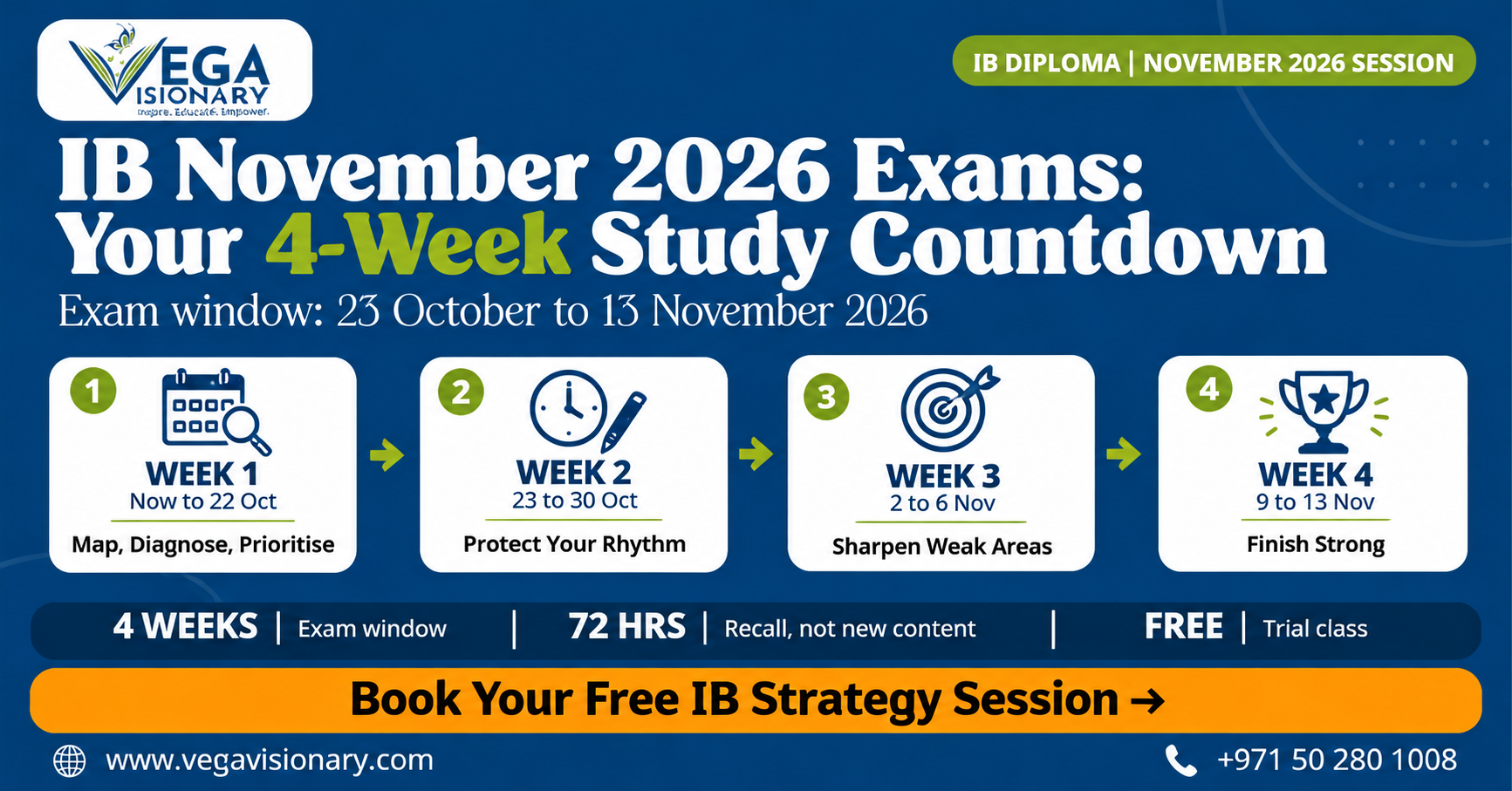
The IB November 2026 exam session is almost here. According to the official IB schedule, the Diploma Programme and Career-related Programme exams run from Friday 23 October to Friday 13 November 2026, which means the final run-up has already begun. If you are sitting IB exams this session, the next few weeks matter more than any other stretch of your preparation.
The November session is the smaller of the IB’s two yearly sessions, and it is common among schools whose academic calendar differs from the May cycle, including many Southern Hemisphere schools, as well as students sitting retakes. That means many candidates are preparing on their own timeline, so a clear plan matters even more.
This guide gives you a practical 4-week study countdown built around the official IB exam timetable. You will also find subject-by-subject revision tips, the mistakes that cost students marks, and answers to the questions we hear most often from IB students and parents. If you want structured guidance alongside this plan, our IB tutoring programme is built for exactly this stage.
Official Exam Dates
The IB Diploma Programme and Career-related Programme November 2026 examination schedule runs from Friday 23 October to Friday 13 November 2026. The schedule applies to all exam zones (A, B and C), and each exam day has a morning session and an afternoon session. Always confirm your personal timetable with your school’s IB Coordinator, because they are the final practical authority on which papers you sit and when.
Local Start Times
Start times depend on your school’s exam zone, which does not change between sessions. Morning sessions start between 08:30 and 10:00 local time, and afternoon sessions start between 12:30 and 14:00. There is no variation within a zone, so once you know your zone you know your start times for the whole session.
How the Timetable Is Built
The IB spreads the subjects with the highest candidature across four weeks so that workload is distributed as evenly as possible, and language and science exams are placed across the weeks where possible. Almost all subjects are scheduled on consecutive days, which means the papers for one subject are often grouped together. A student with Paper 1 and Paper 2 on back-to-back days needs a different plan from one with a gap between them.
Rescheduling Rules
An exam cannot be rescheduled without authorisation from the IB Assessment Division. The IB also notes that it cannot take public, national or school holidays into account because of the number of countries offering the Diploma Programme. If you have a genuine clash or an exceptional circumstance, speak to your coordinator immediately so the request can follow the IB’s assessment procedures.
Because the session runs for four weeks, this countdown is mapped to the actual exam weeks. Adjust the details to your own timetable, but keep the logic: diagnose first, then sharpen, then protect your energy.
Week 1 (Now to 22 October): Map, Diagnose and Prioritise
Start by copying your personal timetable into a calendar you check every day. Mark each paper, the gaps between them and any days with both a morning and an afternoon paper. Then sit one timed past paper in your weakest subject and mark it strictly against the official markscheme to see where marks are really being lost.
Week 2 (23 to 30 October): Exam Week One, Protect Your Rhythm
The first exams begin on Friday 23 October, so this week is about routine as much as revision. Keep a steady sleep schedule, eat properly and plan light, targeted recall sessions for the next paper instead of heavy new learning. After each exam, take ten minutes to note what went well and what to fix, then close the book on that paper completely.
Week 3 (2 to 6 November): Sharpen Weak Areas Between Papers
By now you will have a sense of how the papers feel under real conditions. Use the gaps between exams to target the topics that still lose marks, and keep practising under timed conditions for the papers that remain. For subjects with consecutive papers, plan your preparation for Paper 2 or Paper 3 on the same evening Paper 1 ends, instead of waiting for the next day.
Week 4 (9 to 13 November): Finish Strong
The final week contains the closing papers of the session, and fatigue is now your biggest opponent. The last 72 hours before each paper should be used for recall and technique, not for new content. Keep your notes short, trust the work you have already done, and protect your sleep.
Experience a free live trial class with our expert IB tutors and receive a personalised study plan designed around your timetable and your target grades.
Sciences (Biology, Chemistry and Physics)
In each of these sciences, HL Paper 1 is 2 hours and HL Paper 2 is 2 hours 30 minutes, while SL Paper 1 and SL Paper 2 are both 1 hour 30 minutes. Practise data-based questions and extended responses under timed conditions, and learn to use your data booklet quickly. Write answers in the language of the markscheme, because precise terminology is where many marks are won.
Mathematics (Analysis and Approaches, Applications and Interpretation)
HL Papers 1 and 2 are 2 hours each, SL Papers 1 and 2 are 1 hour 30 minutes each, and HL Paper 3 is 1 hour 15 minutes. Work through full papers rather than isolated topics, and check which papers allow a calculator for your course. Show every step of your working, since method marks can rescue an incorrect final answer.
Languages (Language A and Language B)
Language A Literature HL Paper 1 is 2 hours 15 minutes and SL Paper 1 is 1 hour 15 minutes, while Paper 2 is 1 hour 45 minutes. Practise planning and writing under time pressure, and build a bank of well-chosen quotations and examples. Language B students should practise reading and listening comprehension separately, because each skill demands a different kind of focus.
Individuals and Societies, Business Management and Economics
These subjects reward application, not description. Practise applying theories, tools and diagrams directly to the stimulus material or case study, and learn what each command term (such as evaluate, discuss or justify) expects from your answer. Keep a short list of current, well-explained real-world examples ready to use.
Studying Without a Reverse Plan
Without a plan that counts back from each exam date, the subjects that come early in the timetable get squeezed and the late ones get ignored. Build your plan around your personal exam dates, not around the order of your textbooks.
Only Re-Reading Notes
Re-reading feels productive but rarely exposes gaps. Active recall, timed past papers and error logs show you exactly what you do not yet know, and that is where the extra marks are.
Ignoring Command Terms and Markschemes
Many students know the content but lose marks because their answer does not match what the command term asks for. Compare every practice answer with the markscheme and rewrite it until it matches the expected structure.
Cramming New Content in the Last 72 Hours
The final three days before a paper are for stability, recall and technique. Starting a brand-new topic at this stage usually adds stress without adding marks.
Neglecting Sleep and Routine
A tired mind makes careless errors in even the topics you know best. Consistent sleep, meals and short breaks are part of your exam preparation, not a distraction from it.
What Good Exam-Stage Tutoring Looks Like
In the last weeks before exams, a tutor should not try to re-teach the whole course. The most useful sessions are diagnostic and targeted: marking your timed answers against the markscheme, closing specific gaps and sharpening exam technique. When you compare support options, look for the following.
Why Online Support Works for November Candidates
Vega Visionary is a fully online tutoring and exam-prep company based in Dubai, supporting IB students across PYP, MYP and Diploma Programme levels. Online sessions let you book focused help around your exam timetable from wherever you are, and you can start with a free trial class to see whether the approach suits you.
The IB November 2026 exam session rewards students who prepare with a plan. Know your timetable, diagnose your weak areas early, protect your energy during the exam weeks, and use the last 72 hours before every paper for recall and technique. A calm, structured approach will always outperform last-minute cramming.
If you would like expert help turning this countdown into a personalised plan, explore Vega Visionary IB or message us on WhatsApp at +971 50 280 1008 to book your free trial class.
Written by the Vega Visionary Academic Team
The official IB schedule for the Diploma Programme and Career-related Programme runs from Friday 23 October to Friday 13 November 2026. It applies to all exam zones, with a morning and an afternoon session each day. Confirm your personal timetable with your school’s IB Coordinator.
Start times depend on your school’s exam zone. Morning sessions start between 08:30 and 10:00 local time, and afternoon sessions start between 12:30 and 14:00. The times are local and do not need adjusting for daylight saving.
Map your personal timetable first, then diagnose your weakest areas with timed past papers marked against the markscheme. During the exam weeks, use active recall, short targeted practice and a steady routine. Follow the week-by-week countdown in this guide and adjust it to your own papers.
An IB exam cannot be rescheduled without authorisation from the IB Assessment Division. If you have a clash or an exceptional circumstance, contact your IB Coordinator straight away so they can follow the process set out in the IB’s assessment procedures.
Use the final 72 hours for recall and technique, not new learning. Review one-page summaries, redo questions you previously got wrong, and complete short timed sections on your weakest topics. Protect your sleep and prepare your equipment in advance.
Treat the break between sessions as a reset. Eat something light, drink water, take a short walk and avoid reviewing the paper you just finished. Spend a few minutes on key formulas or definitions for the next paper, then go in with a clear head.
Yes. Vega Visionary provides online IB tutoring for Diploma Programme students, including focused exam preparation, timed practice with feedback and a personalised study plan. You can start with a free trial class to see how the sessions work.
The IB runs two sessions a year, with May being the larger one. The IB’s own schedule states that the November 2027 session is planned to start on Friday 22 October 2027 and end on Friday 12 November 2027, subject to confirmation. Check with your school for the dates that apply to you.