Trending Insights

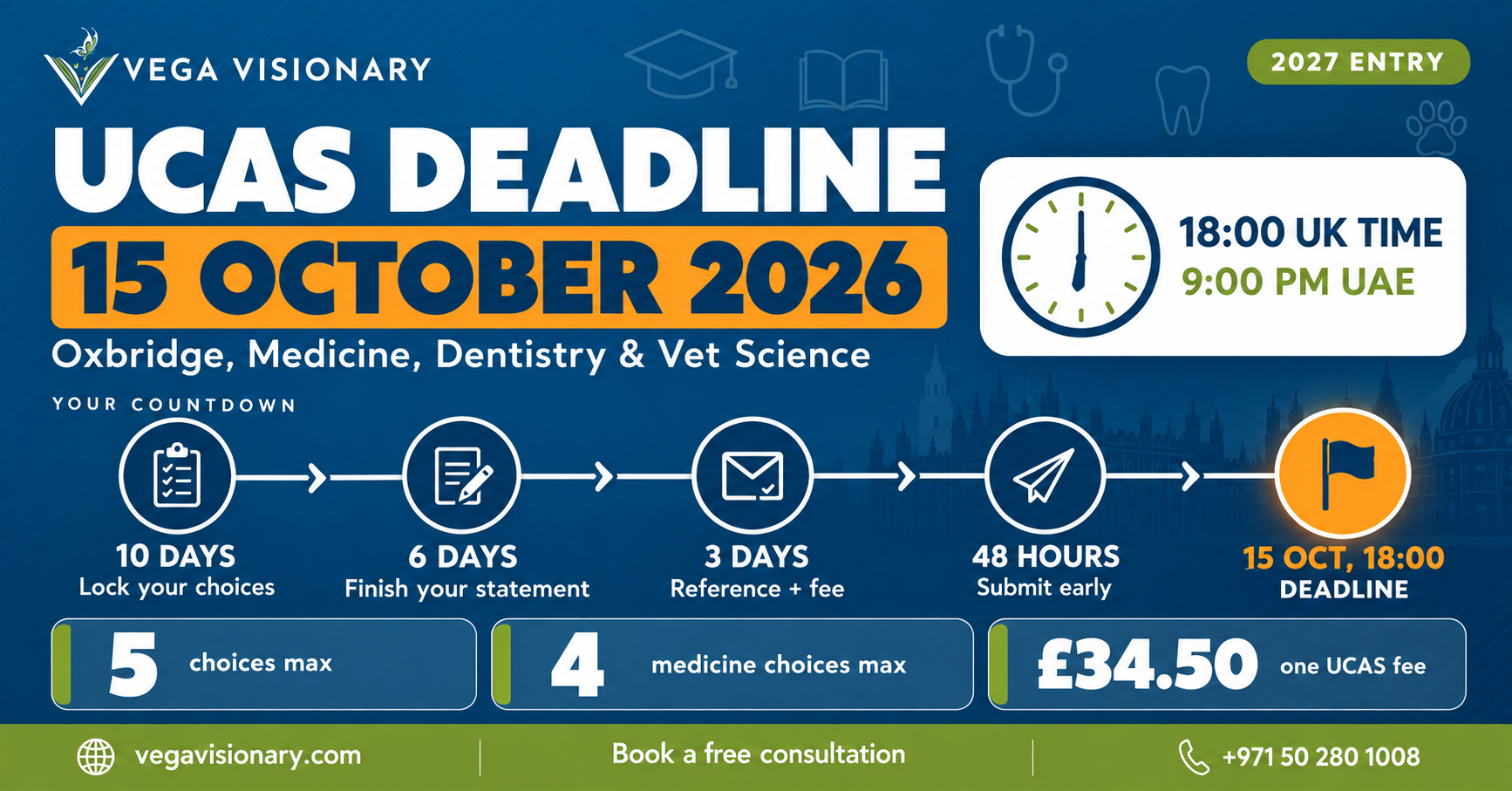
The UCAS deadline for October 15 2026 is the most unforgiving date in the whole university application calendar. If you are applying to Oxford, Cambridge, or to most medicine, dentistry, veterinary medicine and veterinary science courses for 2027 entry, UCAS must receive your completed application by 18:00 UK time on 15 October 2026. For students in the UAE, that is 9:00 pm Gulf Standard Time.
Unlike the main January deadline, there is no grace period for these courses. Miss it and you wait a full year. This countdown guide walks you through the key dates, the steps still left to complete, the new three-question personal statement format, and the mistakes that quietly cost strong applicants their place.
Who must apply by 15 October 2026?
The October deadline covers all Oxford and Cambridge undergraduate courses and most medicine, dentistry, veterinary medicine and veterinary science courses. It is an equal consideration deadline, and late applications for these courses are generally not considered. Always check your chosen course page, because requirements vary between universities.
What time is the deadline?
The cut-off is 18:00 UK time, not midnight. On 15 October the UK is on British Summer Time, so the deadline falls at 9:00 pm in the UAE. Set your own target for at least 48 hours earlier, because your school must complete its reference before you can submit.
Key dates to put in your calendar
These are the dates that matter most for the 2027 entry cycle:
Record demand for early deadline courses
UCAS reported 79,160 applicants to early deadline courses in the 2026 entry cycle, a new record and up 7.4% on the year before. Medicine alone attracted 25,770 applicants, a rise of 10.4%. Official figures for the 2027 cycle are only published after the deadline, so it is sensible to plan for demand to remain high.
What the numbers mean for international applicants
Around 5,040 of those medicine applicants were international, yet UK medical schools offer only around 450 to 500 international places a year. That works out at more than ten applicants for every international place, compared with roughly three applicants per place nationally. A polished, error-free and on-time application is the minimum entry ticket, not a bonus.
Whether you have a full draft or a blank page, this plan helps you spend the remaining time on what counts. Adjust it to your school’s internal deadline, which is often earlier than the UCAS one.
Days 10 to 8: Confirm your choices and course requirements
Lock in your final course list. Re-read the entry requirements, admissions test rules and any extra forms for every university. UCAS allows five choices overall, but no more than four can be medicine, dentistry, veterinary medicine or veterinary science. You also cannot apply to both Oxford and Cambridge in the same cycle.
Days 7 to 5: Finish your personal statement
Aim for a strong final draft, not a perfect one. Your three answers share 4,000 characters including spaces, with at least 350 characters in each. Draft in a document with a character counter, then ask a teacher or tutor to review it for clarity, evidence and repetition.
Days 4 to 3: Reference, predicted grades and education details
Your application cannot be sent until your school or referee has added the reference and predicted grades. Check in with your counsellor now, and verify that every subject, qualification and date in your education section is correct.
Days 2 to 1: Final checks and payment
Read the entire application line by line, preferably aloud. Confirm that the personal statement is pasted correctly, pay the application fee and press submit. Submitting a day early leaves you time to fix any technical issue.
Deadline day: 15 October 2026
Treat 18:00 UK time as a hard stop. Do not leave the final click to the last hour, because heavy traffic and unexpected errors are the most avoidable reasons for a missed deadline.
Experience a free live trial class with our expert tutors and receive a personalised learning plan designed around your goals.
Admissions tests have changed
Oxford has retired its older in-house tests, including the MAT, PAT and TSA, and now uses the shared UAT-UK tests (ESAT, TMUA and TARA) for many courses, alongside the UCAT for medicine and the LNAT for law. Cambridge uses ESAT and TMUA for some courses, while many others rely on college-set assessments around interview. Booking windows for the autumn sittings closed in September, so confirm your registration status immediately and check the official page for your course.
Cambridge: complete My Cambridge Application
After submitting to UCAS, Cambridge applicants must complete My Cambridge Application, currently listed with a deadline of 22 October 2026 at 18:00 UK time. Do not treat this as a second chance to start work, because it is a separate required step.
Oxford: written work and course-specific extras
Some Oxford courses ask for written work after your UCAS application is in. Check your course page now and block out time straight after you submit so the work is not rushed.
Interviews and offers
Shortlisted applicants are usually invited to interview in December, with decisions typically following in January. Start practising how to think aloud through unfamiliar problems now, because interview skill grows with repetition.
Use your UCAT score to shape your choices
For most UK medicine and dentistry courses, your UCAT result strongly influences where you should apply. By now your result should be in hand, because the testing window closes before the UCAS deadline. Match your score to each school’s selection method when choosing your four medical courses, as a choice that fits your profile is worth more than a famous name.
Work experience and reflection
You do not need a hospital placement to write a strong medical personal statement. Care roles, volunteering, paid work and structured virtual experience can all show insight when you reflect on what you learned about people, teamwork and care. Admissions teams value reflection far more than a long list of placements.
Academic requirements
Check each school’s grade and subject requirements, including required chemistry or biology. For IB students, Cambridge Medicine’s published offer level for 2027 entry is reported at 41 to 42 points with 776 at Higher Level, so make sure your predicted grades match the courses you choose.
UCAS replaced the single free-form essay with three structured questions from the 2026 entry cycle, so 2027 applicants are only the second cohort to use this format. Many example statements online still follow the old style, so be careful what you copy.
The three questions you need to answer
UCAS asks every applicant:
How to split your 4,000 characters
The three answers share one limit of 4,000 characters including spaces, and each answer needs at least 350 characters. The questions themselves do not count. Universities see your answers separately but assess them as one statement, so avoid using the same example three times. A common starting point is roughly 1,100, 1,300 and 1,600 characters, adjusted to where your strongest evidence sits.
Convert the deadline to your time zone
18:00 UK time on 15 October 2026 is 9:00 pm in the UAE. Aim to submit by the morning of 14 October so a late reference or payment problem does not decide your year.
Coordinate with your school early
Your counsellor or teacher must add your reference and predicted grades. Many schools set internal deadlines well before the UCAS date, so confirm yours today and share your final statement as soon as it is ready.
Check English language and fee requirements
International applicants should check each university’s English language requirement, such as IELTS, and confirm their fee status. Our tutors support UCAT, IELTS, A-Level and IB preparation for students who want expert help alongside their application.
The UCAS deadline for October 15 2026 rewards students who plan backwards from the date, not forwards from a feeling of readiness. Confirm your choices, finish your personal statement, secure your reference and submit early. If you want expert support with UCAT, IELTS, A-Level or IB preparation alongside your application, visit Vegavisionary.com or message us on WhatsApp at +971 50 280 1008.
Written by the Vega Visionary Team
For 2027 entry, UCAS must receive your application by 18:00 UK time on 15 October 2026. This applies to all Oxford and Cambridge undergraduate courses and most medicine, dentistry, veterinary medicine and veterinary science courses.
The deadline of 18:00 UK time is 9:00 pm in the UAE. Aim to submit well before then, ideally by the morning of 14 October, to leave room for any reference or payment issue.
For Oxbridge and the other October deadline courses, a late application is generally not an option for this cycle. You can still apply to other courses by the main deadline of 13 January 2027, or plan a fresh application for next year.
No. You can apply to either Oxford or Cambridge in a single admissions cycle, not both. Choose the university whose course content, teaching style and admissions process suit you best.
UCAS allows five choices overall, but no more than four can be medicine, dentistry, veterinary medicine or veterinary science. Your fifth choice can be a different course, including one with the later January deadline.
You answer three questions within a shared limit of 4,000 characters including spaces, and each answer needs at least 350 characters. The questions themselves do not count towards the limit.
Many courses do. Oxford now uses the UAT-UK tests (ESAT, TMUA and TARA), the UCAT for medicine and the LNAT for law, while Cambridge uses some UAT-UK tests and many college-set assessments. Check the exact requirement on your course page, because it differs by subject.
You need your personal details, education history, up to five course choices, your three-question personal statement, a school reference with predicted grades, and payment of the application fee. International applicants should also check each university’s English language requirement.