Trending Insights

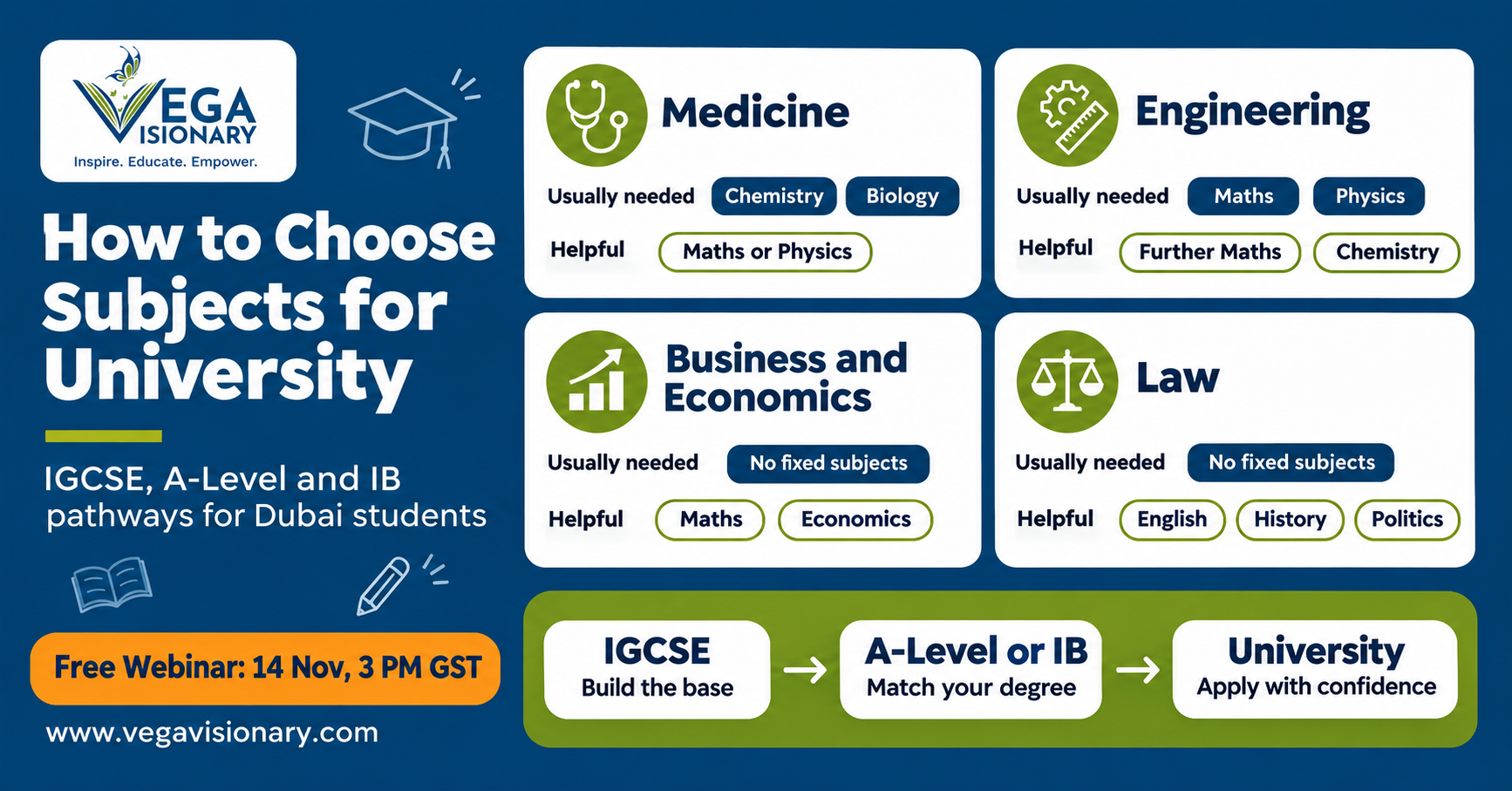
Choosing subjects is the first real university decision a student makes, and in Dubai it often arrives earlier than families expect. The subjects you pick at IGCSE, A-Level or IB decide which degrees you can apply for, which universities will consider you, and how strong your application looks to an admissions team.
If you are searching for how to choose A level subjects, or you want a clear process for subject selection for university across the British curriculum and the IB, this guide walks you through it. It covers the key dates, a step-by-step method, subject pathway tables for medicine, engineering, business and law, and answers to the questions Dubai families ask most.
Timing matters. Term 2 subject-option decisions start in January, and the main UCAS deadline for 2027 entry is 13 January 2027. Vega Visionary is also hosting a free university guidance webinar on 14 November at 3 PM GST, which is well worth attending before any option form is signed.
Subjects decide which degrees you can apply for
Some degrees have fixed entry requirements. Medicine usually asks for Chemistry and often Biology, while engineering usually asks for Maths and Physics. If a required subject is missing, strong grades in other subjects will rarely make up for it. Cambridge, for example, asks Medicine applicants for Chemistry plus two of Maths, Biology and Physics, and Engineering applicants for Maths and Physics. Always check the current requirements for each course.
Subjects signal genuine interest
Even where no subject is required, admissions teams read your subject mix as evidence of commitment. A student applying for economics with Maths and Economics tells a clearer story than one whose subjects have no link to the degree.
Choices at 14 and 16 shape choices at 18
Your IGCSE options feed into your A-Level or IB options. Dropping separate sciences or Extended Maths at IGCSE can make some science pathways harder to reach later, depending on your school’s entry rules.
These dates frame the subject decision for students applying to UK universities through UCAS.
If you are in Year 13 or Grade 12 and have questions about what is still possible for 2027 entry, speak to your school counsellor straight away. If you are in Year 9 to Year 12, the same calendar repeats for your own application year, so the subjects you choose now will count.
1. Start with two or three degree ideas, not one job title
Most 15 and 16 year olds do not know their final career, and that is fine. Pick two or three degree areas you are curious about, such as medicine, engineering or business, and work backwards from there. This keeps your options realistic without locking you in too early.
2. Check the hard requirements first
Use UCAS course search, the course page of each target university, and the Russell Group Informed Choices tool. Informed Choices shows which subjects are essential or useful for specific degrees, and it applies to students at all kinds of schools, not only Russell Group applicants.
3. Sort every subject into required, preferred or open
Admissions requirements usually fall into three groups, and knowing which group you are in changes how you choose.
4. Balance interest, ability and workload
A strong grade in a subject you enjoy usually beats a weaker grade in a subject chosen only for its reputation. Be honest about your strengths, ask teachers for predicted-grade feedback, and think about the total workload across your subjects.
5. Keep your options open if you are undecided
If you are not sure yet, build a balanced mix. Maths is accepted or preferred by a wide range of courses, including economics, computer science and many sciences. Pairing it with a science and a humanities or language subject keeps several pathways open.
6. Match your subjects to the countries you may apply to
UK courses publish specific subject requirements. US universities often look at the breadth and rigour of your whole programme rather than a fixed subject list. Canada and Australia often publish prerequisites for competitive programmes that are similar to UK ones. If you are considering more than one country, check the published requirements for each.
Our British curriculum tutoring in Dubai students often ask us where to begin with A-Levels. Start with the points below.
Remember that most offers are built around three A-Levels
Because most UK offers are based on three subjects, every A-Level choice carries real weight. A weak third subject can cost you an offer.
Understand what happened to facilitating subjects
Many families still hear about a list of “facilitating subjects”. The Russell Group retired that label in 2019 and replaced it with the Informed Choices tool, because the list was often misread as a strict rule. Maths, sciences, languages, history and English still open many doors, but you should check the degree you want rather than rely on an old list.
Choose subjects you can score highly in
Universities make offers based on grades. Choose subjects where you can realistically reach the top grades, and avoid picking a subject only because it sounds impressive.
Consider a contrasting subject where it helps
Some medical schools value a broader academic base, so a non-science subject such as a modern language can add balance next to Chemistry and Biology. Check each medical school’s policy before deciding.
Ask these three questions before submitting an option form
Choose Wisely: The Complete Guide to Subjects, Universities and Careers. Learn how to pick the right subject combinations for your dream university and build a strong profile, with guidance from our expert team. Open to students and parents across the globe.
The IB Diploma combines three Higher Level (HL) and three Standard Level (SL) subjects. If you are studying the IB in Dubai, our IB tutoring team can help you plan HL and SL choices around your target degrees.
HL choices carry the most weight
Admissions teams pay the greatest attention to your three HL subjects, and many competitive courses name specific HL subjects. Medicine usually expects HL Chemistry and HL Biology, while engineering usually expects HL Maths and HL Physics.
Think carefully about Maths Analysis and Approaches versus Applications and Interpretation
Engineering, physics and many economics courses prefer HL Maths Analysis and Approaches. Biological and chemical sciences often accept Maths at Standard Level. Check each course, because the exact rule varies by university.
Use SL subjects to protect your overall score
Pick HL subjects that fit your degree, and choose SL subjects where you can score well. A strong overall total matters as much as the subject mix.
If you are choosing IGCSE options, read our complete guide to GCSE, IGCSE and A-Levels for a full overview of how the qualifications fit together.
Take the core, then add breadth
English, Maths and the sciences form the base of almost every pathway. Add subjects that match your interests so your timetable stays balanced.
Choose separate sciences for science-led pathways
For medicine, veterinary science or engineering, many schools recommend separate Chemistry, Biology and Physics, together with Extended Maths. This gives you the strongest platform for A-Level or IB sciences.
Add a humanities or language subject for other pathways
Law, business and social science pathways benefit from essay-based subjects such as History, English Literature or a modern language.
Check your school’s A-Level entry grades
Many sixth forms set minimum IGCSE grades for A-Level subjects, especially Maths and the sciences. Ask your school early so there are no surprises in Year 11.
The table below gives a broad guide to typical subject pathways. It is a starting point only, because requirements differ between universities and can change between years.
| Degree Area | A-Level Pathway | IB Pathway | IGCSE Foundation |
|---|---|---|---|
| Medicine | Chemistry and Biology, with Maths or Physics often the third subject | HL Chemistry and HL Biology, with Maths SL or HL commonly accepted | Chemistry, Biology, Physics and Extended Maths |
| Engineering | Maths and Physics, with Further Maths helpful and Chemistry needed for chemical engineering | HL Maths Analysis and Approaches and HL Physics, with HL Chemistry for chemical engineering | Extended Maths, Physics and Chemistry |
| Business and Economics | No fixed subjects at most universities, but Maths is often required or preferred, especially for economics and finance | HL Maths often expected for economics, with Economics or Business Management helpful | Maths, English, and Economics or Business Studies if offered |
| Law | No fixed subjects, but essay-based subjects such as English Literature, History and Politics help | No specific HL subject, but HL English or History shows strong writing and analysis | English Language, English Literature and History |
Before you finalise any option, confirm the exact entry requirements on the course page of every university on your shortlist.
Subjects are only one part of a strong application. Admissions teams also look at your grades, your personal statement, and the experiences that show your interest in a field. Families should also check whether a degree is feasible, including internship opportunities, job prospects and nationality-related considerations.
These are exactly the topics our free university guidance webinar covers on 14 November at 3 PM GST: subject selection, the best subject combinations for university admissions, profile building, and how to explore university options with their requirements.
Subject selection for university is easier when you work backwards from a few degree ideas, check the real entry requirements, and make choices early. Whether you study IGCSE, A-Level or the IB, the right subject mix keeps your options open and tells admissions teams a clear story about your goals.
Ready to plan your subject pathway? Visit Vegavisionary.com or message us on WhatsApp at +971 507 943 806 to speak with our expert team.
Written by the Vega Visionary Team
Choose a balanced mix that keeps several pathways open. Maths, at least one science and a humanities or language subject is a sensible combination. Then shortlist two or three degree areas and check their requirements before you finalise your options.
Medicine usually requires Chemistry and often Biology, with Maths or Physics commonly accepted as a third subject. Some medical schools also value a contrasting subject. Because rules differ by university, check each medical school’s entry requirements before you choose.
Most engineering degrees expect HL Maths, usually Analysis and Approaches, and HL Physics. Chemical engineering usually also needs Chemistry. Read the specific course page, as a few departments accept Maths at a different level alongside strong results elsewhere.
No. The Russell Group retired its list of facilitating subjects in 2019 and now provides the Informed Choices tool, which shows the subjects that are essential or useful for each degree. Check the degree you want rather than relying on a general list.
Most law and business courses do not name fixed subjects, but some universities prefer Maths for economics, finance and certain business courses. For law, essay-based subjects such as English Literature or History are useful. Always confirm on the course page.
The main UCAS deadline for most undergraduate courses is 6 PM UK time on 13 January 2027, which is 10 PM in the UAE. The earlier deadline for Oxford, Cambridge, Medicine, Dentistry and Veterinary courses was 15 October 2026.
Many schools allow changes only within a short window at the start of the course, and the rules vary. Ask your school about its policy before you choose, and do not assume you can switch later.
Yes. The webinar takes place on 14 November at 3 PM GST. It is free and open to students and parents across the globe. It covers subject selection, subject combinations for university admissions, profile building, and exploring university options.