Trending Insights

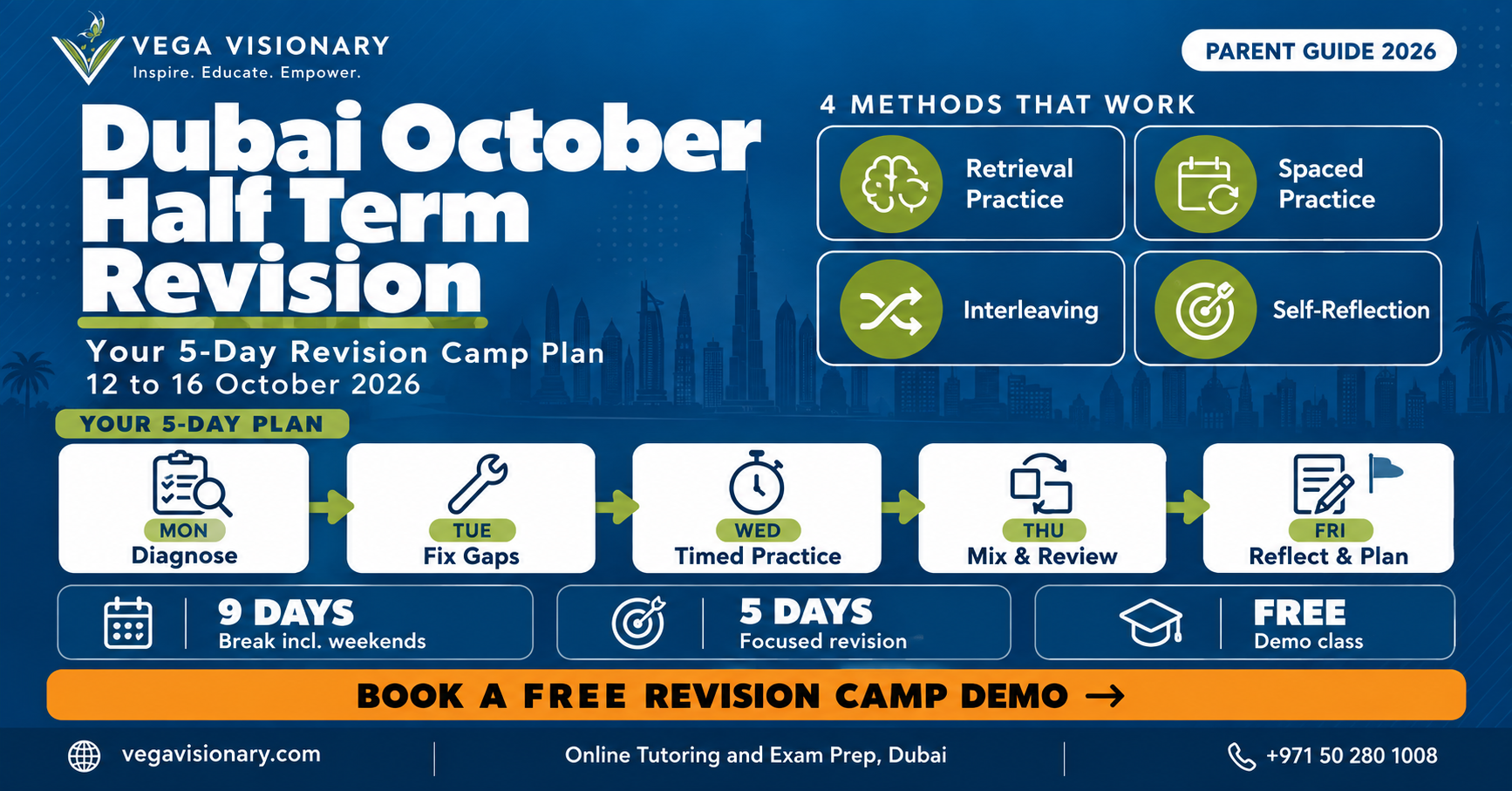
Dubai’s October half term is one of the most useful pauses in the whole school year. In 2026, the mid-term break runs from Monday 12 October to Friday 16 October, and classes resume on Monday 19 October. Add the weekends on either side and many families have a full nine days away from the classroom.
For parents, the big question is how to use that time well. A holiday matters, but so does the long run of term one that follows. This guide explains the exact dates, why half term is such a strong revision window, and how a short, structured revision camp can help your child return to school calmer, clearer and better prepared.
The official dates
Under the unified academic calendar issued by the UAE Ministry of Education, which KHDA has told Dubai private schools to follow, the first mid-term break of the 2026-27 academic year lasts five school days. The key dates are:
Check your own school’s calendar
Several Dubai British schools recently told parents that their break had moved forward by a week, from 19 to 23 October to 12 to 16 October, to match the unified calendar. Schools following other curricula, including some Indian, Pakistani and Bangladeshi schools, can set different dates, and April-start schools have their own structure. Always confirm with your school before you plan anything.
Plan before the break begins
Families who decide what the week looks like before 12 October tend to have a far more productive break. Deciding on the first morning of the holiday is how a good week quietly slips away.
A natural reset point
Term one is about thirteen weeks long, and the October break is the first scheduled pause. By now, students have met new teachers, new topics and often their first assessments. Half term is the ideal moment to see what has stuck, what has not and what needs rebuilding before the pace increases.
Weeks of school still ahead
After classes resume on 19 October, there are roughly eight school weeks before the winter break begins on 14 December. Topics studied in September and October are the ones students will meet again in end-of-term tests and, for older students, mock exams. Revising them now is far easier than relearning them in December.
Small gaps become big stress
Misunderstandings that go unaddressed in October tend to grow. A student who is shaky on algebra, essay structure or a key physics concept will find each new topic harder. A focused week now can close those gaps while they are still small.
A revision camp is a short, intensive and structured block of study, usually over several days, with clear goals, expert guidance and regular feedback. It is different from simply telling a child to “revise” at home, because the plan, the practice and the accountability are built in.
The building blocks of a good revision camp
Whether it runs online or in person, a strong camp should include:
Why online can suit Dubai families
Online revision camps remove the commute, which is useful when families are travelling, hosting relatives or simply keeping the week relaxed. Students join live sessions from home with expert tutors, then return to their own routine in the afternoon.
Use this structure as a starting point and adjust it to your child’s age, subjects and school timetable. A few focused hours each day are far more effective than long, tiring days.
Monday 12 October: Diagnose
Start with a short quiz or a set of past paper questions in each priority subject. Mark it together and list the topics that need the most attention. This list becomes the plan for the rest of the week.
Tuesday 13 October: Fix the biggest gaps
Spend the day on the weakest high-priority topics. Learn or relearn the idea, then close the notes and answer questions from memory. Finish with a short quiz to confirm it is sticking.
Wednesday 14 October: Practise under timed conditions
Use exam-style questions with a timer. Timed practice shows how a student performs under pressure, and the mark scheme shows exactly where marks are lost.
Thursday 15 October: Mix topics and review
Blend questions from different topics in the same session, then revisit Monday’s quiz. Mixing topics feels harder, but it teaches students to choose the right method for a question, which is exactly what exams demand.
Friday 16 October: Reflect, plan and rest
Review what improved, rewrite the study plan for the first weeks back and finish early. Ending the week with a calm plan and a free afternoon sends students back to school feeling in control, not exhausted.
The weekends: protect real rest
Keep the weekends free for family, sport, sleep and play. Rest is part of learning, because good sleep helps memory settle.
Experience a free live trial class with our expert tutors and receive a personalised learning plan designed around your goals.
IGCSE, GCSE and Years 10 to 11
Focus on core topics in maths, sciences and English, and begin working with past papers and mark schemes. Students on Cambridge or Pearson Edexcel IGCSE courses, especially in Year 11, should treat this break as the start of their mock exam preparation.
A-Level and Years 12 to 13
Prioritise the toughest topics and exam technique in each subject. Year 13 students applying to Oxford, Cambridge, medicine, dentistry or veterinary science should note that the UCAS deadline falls on Thursday 15 October at 18:00 UK time, which is 9:00 pm in the UAE, in the middle of the break. Finish and submit the application first, then revise.
IB Diploma, MYP and PYP
DP students can use the week to review core subject content and make progress on the Extended Essay and internal assessments. MYP and PYP learners benefit from lighter, skills-based revision in reading, writing and maths fluency to build confidence.
SAT and other test preparation
The digital SAT is offered on 7 November and 5 December 2026. For the 7 November test, the regular registration deadline is 23 October, so half term is a natural time to take a full practice test and decide whether to register. Check the College Board website for the latest dates and fees.
Primary and KS3 students
Younger learners need shorter sessions, games and confidence building rather than heavy exam practice. Thirty to sixty minutes a day of focused reading, number fluency and writing practice is usually plenty.
Not all revision is equal. Research summarised by organisations such as the Education Endowment Foundation highlights a handful of methods that consistently help students remember more.
Retrieval practice
Retrieval practice means pulling information out of memory through quizzes, flashcards and blank-page recall, instead of rereading notes. It feels harder than rereading, but it is one of the best-supported ways to build lasting memory.
Spaced practice
Spaced practice means returning to a topic over several days instead of studying it once in a long block. Over the half term week, revisit Monday’s topics on Wednesday and again on Friday.
Interleaving
Interleaving mixes different topics or question types in one session. It feels less smooth than studying one topic at a time, but it trains students to recognise which method a question needs.
Metacognition and self-reflection
Students who plan, monitor and review their own learning tend to make stronger progress. Ask your child to rate their confidence in each topic before and after a quiz, then compare it with their actual score.
Agree the plan together
Sit down before the break and let your child help choose subjects, timings and goals. Students who help build the plan are more likely to follow it.
Protect sleep and routine
Keep bedtimes and wake-up times reasonably close to the school routine, so the return to school on 19 October is not a shock.
Ask your child to teach you
Asking your child to explain a topic to you is a simple, low-pressure form of retrieval practice. You do not need to know the subject, because the explanation itself shows what they understand.
Praise effort and process
Celebrate focus, consistency and improvement rather than marks alone. This keeps motivation high and reduces exam anxiety.
Dubai’s October half term is short, but used well it can set the tone for the rest of term one. Plan the week, mix rest with focused practice and keep the momentum going after 19 October. If your child would benefit from expert-led online revision with a clear plan, visit Vegavisionary.com or message us on WhatsApp at +971 50 280 1008.
Written by the Vega Visionary Team
For schools following the unified academic calendar, the mid-term break runs from Monday 12 October to Friday 16 October 2026, with classes resuming on Monday 19 October. Including the weekends on either side, that is a nine-day break.
Not always. Most Dubai private schools follow the unified calendar, and several moved their break from 19 to 23 October to 12 to 16 October. Schools following other curricula can set different dates, so confirm with your own school.
As a general guide, older students in IGCSE, A-Level and IB Diploma programmes can manage around three to four hours of focused study split into blocks with breaks, while younger children do well with thirty to sixty minutes. Quality matters more than quantity, so adjust to your child’s needs.
A revision camp adds structure, expert feedback and accountability, which many students find hard to create alone. Self-study can work well for motivated students with a clear plan, and many families combine both.
Start with the subjects and topics where your child feels least confident or where upcoming tests and mock exams are closest. Use a short diagnostic quiz to confirm, then keep some time for stronger subjects so they stay sharp.
Yes. Live online sessions with expert tutors let students revise from home with no commute, which suits families who are travelling or want a relaxed week. Look for a camp with a diagnostic check, active practice and daily feedback.
Absolutely. Plan at least one full day off, protect the weekends and keep daily downtime for sport, family and sleep. A rested student learns more in fewer hours than a tired one.
Half term is a strong time to take a full SAT practice test, since the 7 November test has a registration deadline of 23 October. For mock exams, use the week to close gaps in topics studied since September, then continue with short weekly revision sessions after classes resume.