Trending Insights

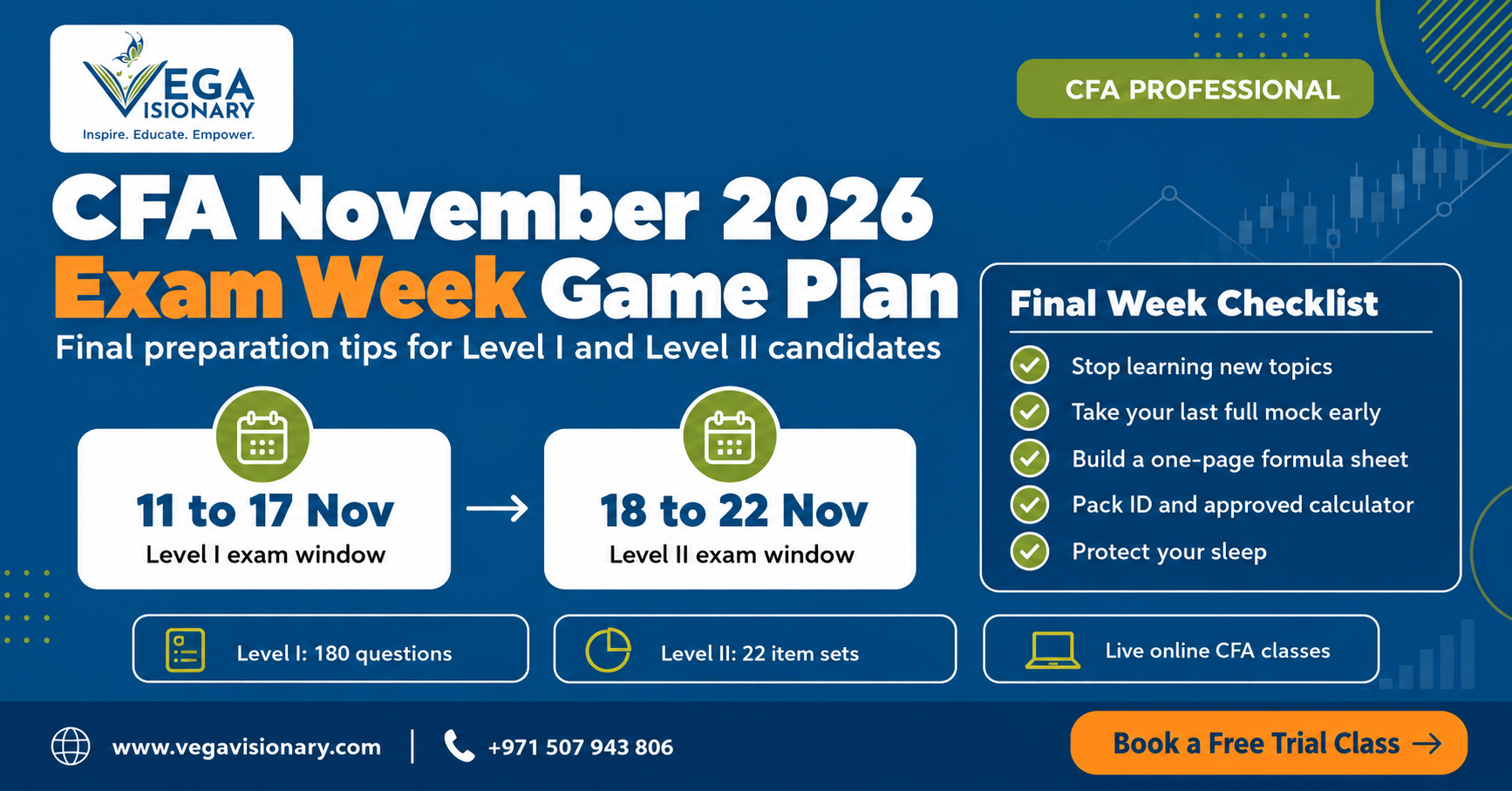
The CFA November 2026 exam window is almost here. Level I candidates sit their exam from 11 to 17 November 2026, and Level II candidates follow from 18 to 22 November 2026. If you have studied for months, the final days are about protecting what you already know, not racing to learn more.
This guide is written for Level I and Level II candidates, including students in Dubai and across the UAE who are balancing work, study and exam logistics. It covers the exam week schedule, a smart final-week study plan, level-specific tips, an exam day checklist, how to manage stress and what to do once the exam is over.
Before planning your last few days, confirm the basics in your CFA Institute account and on your test centre appointment. These are the key points for the November 2026 window:
Check your appointment date, time and test centre address now, not on the morning of the exam. A small mix-up with a booking is far easier to fix a week ahead than on the day itself.
1. Stop learning brand-new material
The last week is for consolidation. Introducing new topics now tends to create anxiety and push out knowledge you already hold. Spend your time strengthening what you have studied rather than chasing every remaining gap.
2. Prioritise high-weight topics and your weakest areas
Review your mock exam and question bank results to find where you lose the most marks. Balance two goals: secure the heavily weighted topics, and tidy up weaker areas you can realistically improve in a few days. Ethics and Professional Standards deserves a final read at both levels because it carries significant weight and rewards careful reading.
3. Take your last full mock early in the week
Complete one final timed mock exam three or four days before your test date, then spend the next day reviewing every mistake. A mock the night before leaves no time to learn from it and can dent your confidence.
4. Build a one-page formula and concept sheet
Condense key formulas, ratios and decision rules onto a single page. Writing them out from memory is one of the quickest ways to find what has not stuck. Re-read this sheet each day, and keep it for the morning of the exam.
5. Protect your sleep and routine
Sleep does more for recall than an extra late-night session. Keep your study blocks short, fix your wake-up time, and match your practice hours to your exam appointment time so your brain is sharp when it counts.
Know the format and pace yourself
Level I is made up of 180 multiple-choice questions, split into two sessions of 90 questions, each lasting 135 minutes. That works out to roughly a minute and a half per question. Practise settling into that rhythm so no single question drains your time.
Use elimination and move on
Level I rewards breadth. If a question stumps you after a fair attempt, flag it, make your best guess and keep moving. There is no benefit to leaving questions blank, and easier questions later in the session carry the same marks.
Revisit definitions, formulas and the Code and Standards
Many Level I questions test whether you can recall a concept accurately and apply it quickly. Use your final days for rapid revision of core definitions, key formulas and the Ethics standards rather than long, heavy problem sets.
Practise the item set format
Level II is built around item sets, which are case-based vignettes followed by questions. The exam contains 22 item sets with 88 questions in total, delivered in two sessions of 132 minutes. That gives you around 12 minutes per item set, so practise reading the vignette quickly and pulling out only the data you need.
Read the questions first, then the vignette
Many candidates save time by skimming the questions before reading the case. You then read with a purpose and spot the relevant numbers and statements faster. Try this approach in your last mock so it feels natural on exam day.
Focus on application and valuation
Level II tests whether you can apply concepts, not just define them. Revisit your most common error patterns, especially in valuation, financial statement analysis, fixed income and derivatives, and review how you set up calculations, not only the final answers.
Do not neglect Ethics item sets
Ethics item sets can be some of the most reliable marks on the paper when you read the case slowly and match the facts to the relevant standard. A final review of the Standards and their application is time well spent.
Experience a free live trial class with our expert tutors and receive a personalised learning plan designed around your goals.
Good logistics remove avoidable stress. Prepare the following the evening before:
Aim to arrive well ahead of your appointment, ideally at least 30 minutes early, so check-in does not rush you. If you are travelling to a test centre in Dubai or elsewhere in the UAE, allow for traffic and parking, particularly on weekdays.
Keep your study sessions short and focused
Two or three focused blocks of 60 to 90 minutes are far more useful than long, tiring days. Take proper breaks, move around and stay hydrated.
Avoid comparison and last-minute panic
Online forums can be full of candidates sharing how many hours they studied or how many mocks they passed. Comparing yourself rarely helps. Focus on your own plan and trust the preparation you have already done.
Stay steady between exam sessions
If one section feels difficult, leave it behind. Use the break to reset, eat something light and approach the next session with a clear head. Every question is worth the same, and one hard set does not decide your result.
Once you have finished, give yourself a proper rest. Results are usually released several weeks after the exam, commonly about five to seven weeks, and they appear in your CFA Institute account. It can occasionally take a little longer, so avoid constant refreshing.
Level I candidates who pass can plan for Level II, which is offered in May, August and November. Level II candidates who pass move on to Level III, which is offered in February and August. Planning your next level early, even while you wait for results, helps you keep momentum without burning out.
Vega Visionary is a Dubai-based online tutoring and exam-prep company. Our CFA classes are delivered fully online, so you can study from home, from the office or while travelling.
Our tutors help candidates review mock exam results, strengthen weak topics and build a study plan around their level, schedule and next exam window. Whether you are in the final week before November or planning ahead for the next CFA window, you can start with a free live trial class and a personalised learning plan.
CFA exam week is about calm, consistent execution. Review smartly, take your last mock early, prepare your exam day essentials and keep your energy steady. You have already put in the hard work, so trust it. For guidance before, during or after your exam, visit Vegavisionary.com or message us on WhatsApp at +971 507 943 806 to start with a free trial class.
Written by the Vega Visionary Team
The Level I exam window runs from 11 to 17 November 2026, and the Level II window runs from 18 to 22 November 2026. Confirm your exact appointment date and time in your CFA Institute account and your test centre booking.
No. The November window is for Level I and Level II only. Level III is offered in February and August.
Level I has 180 multiple-choice questions across two sessions of 90 questions. Level II has 22 item sets with 88 questions in total, split across two sessions.
CFA Institute permits the Texas Instruments BA II Plus (any version) and the TI-30XS MultiView. Practise with your chosen calculator in every mock so it feels familiar on exam day.
It is better not to. The final week works best for revision, error review and light practice. New material at this stage often adds stress without adding much to your score.
Most candidates benefit from one or two full-length timed mocks in the final two weeks. The key is to review each mock carefully and fix the patterns behind your mistakes, rather than simply taking as many as possible.
Level I and Level II results are usually released several weeks after the exam, commonly about five to seven weeks. They are published in your CFA Institute account, and release can occasionally take a little longer.
Feeling nervous is normal. Concentrate on your highest-value topics, review your mock errors and keep your routine steady. Rescheduling and deferral options have fixed deadlines, so check your CFA Institute account to see what is still available. A tutor can also help you judge your readiness and prioritise your remaining days.