Trending Insights

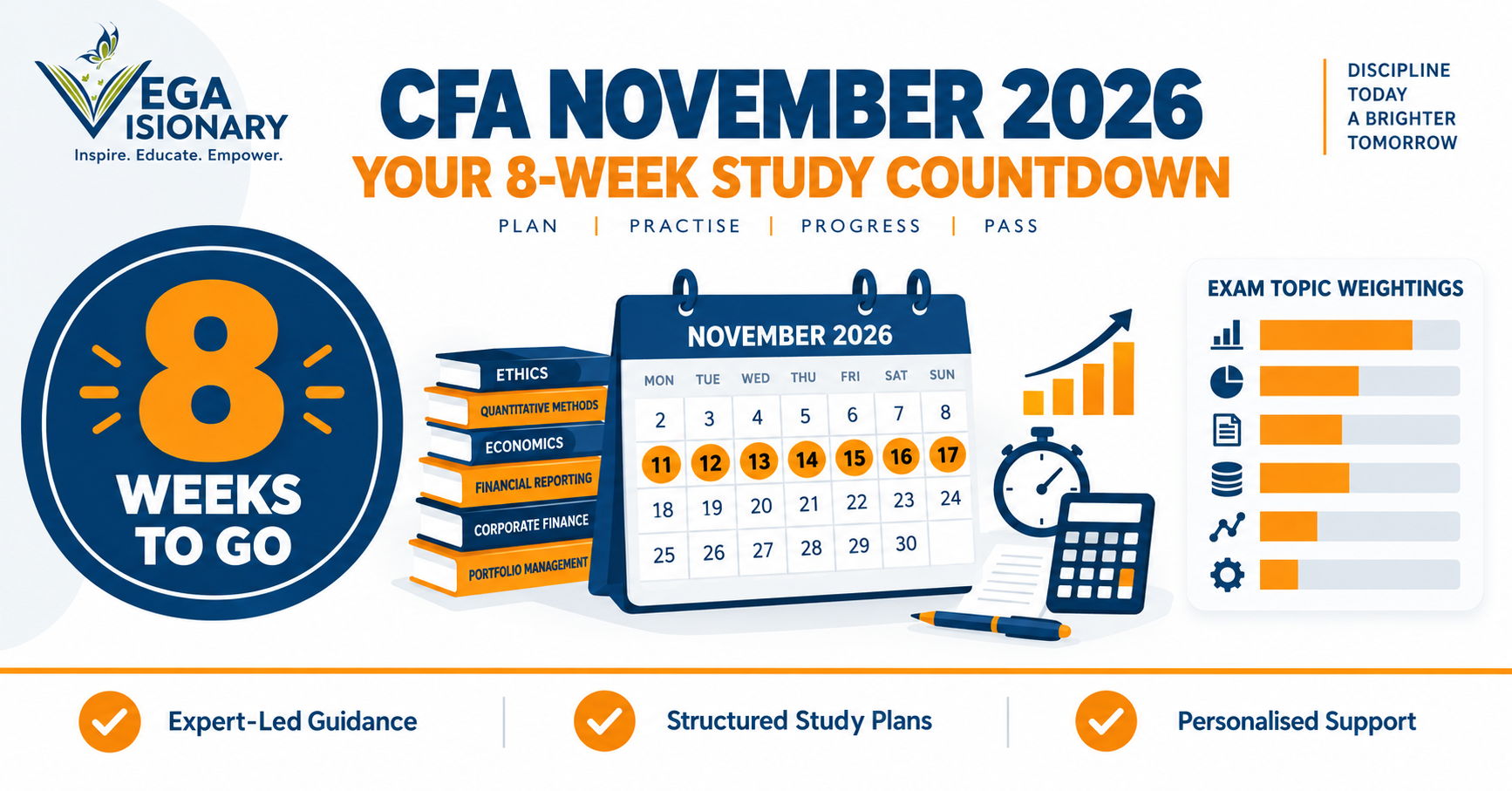
If you are reading this in mid September 2026, the CFA Level I November 2026 exam is roughly eight weeks away. The window runs from 11 to 17 November 2026, with Level II candidates sitting from 18 to 22 November 2026. Standard registration for this cycle closed on 11 August 2026 and the scheduling deadline passed on 18 August 2026, so if you are registered, the only variable left in the equation is how you use the next eight weeks.
This guide breaks that time down into a realistic, topic weighted study plan based on the current 2026 CFA Level I curriculum, along with the exam format, common last minute mistakes, and the logistics you should not leave until exam week.
The 2026 CFA Level I curriculum is unchanged from 2025: 93 Learning Modules, 365 Learning Outcome Statements, spread across the same ten topic areas. That stability is good news if you started preparing earlier this year, because any 2025 or 2026 dated study material is still valid for the November sitting. The one addition worth knowing about is the Practical Skills Module, which became mandatory in 2026: candidates must complete one of three options, Python, Data Science and AI, or Analyst Skills, alongside the core curriculum.
If You Have Not Registered Yet
Standard registration and scheduling for November 2026 have both closed. If you are only starting your CFA journey now, your realistic options are the February 2027 window for Level I and Level III, or the May 2027 window for Level I and Level II. Registration for February 2027 closes on 5 November 2026, so there is still time to plan a proper study runway rather than rushing into November.
If You Are Already Registered
Your rescheduling deadline for Level I, if you ever need to move your appointment within the window, falls on 31 October 2026 and carries a fee. Beyond that date, you are locked into whatever slot you booked between 11 and 17 November, so use the next eight weeks assuming that date is fixed.
Before building a study plan, it helps to know exactly what you are studying for. The Level I exam has not changed in structure for 2026.
The single biggest mistake candidates make in the final stretch is spending time proportional to how much they enjoy a topic rather than how much it is actually worth on exam day. The CFA Institute publishes official weight ranges for all ten topics, and they should dictate your calendar, not your comfort zone.
The Four Topics That Decide Your Score
Ethics, Financial Statement Analysis, Equity Investments, and Fixed Income together can account for anywhere between 48 and 62 percent of your total exam. If your eight week plan does not give these four topics the lion’s share of your hours, your preparation has a structural problem before you have even opened a book. Derivatives and Alternative Investments, by contrast, are tested mostly at a conceptual level at Level I, so treat them as lower intensity, application focused revision rather than deep dives.
CFA Institute recommends around 300 to 350 hours of study for Level I. Spread across eight weeks, that works out to roughly 5 to 6 hours a day if you are starting from a blank slate, or considerably less if you have already covered the curriculum once and are now in revision mode. Adjust the intensity below to where you actually stand, but keep the sequence and the weighting intact.
Weeks 1 and 2: Build the Foundation
Start with Quantitative Methods, Economics, and Corporate Issuers. None of these carry the heaviest weight, but they build the mathematical and conceptual vocabulary you will lean on in Fixed Income, Equity, and Portfolio Management later. Rushing this stage to “save time” for higher weight topics almost always backfires, because half of the confusion candidates report in Fixed Income and Derivatives traces back to shaky quant fundamentals.
Weeks 3 and 4: Attack the Heavyweights
This is where Financial Statement Analysis and Fixed Income get the bulk of your hours. Both are dense, formula heavy, and together can represent close to a quarter of your total score. Work through practice questions topic by topic as you go rather than saving all questions for the end. FSA in particular rewards candidates who can move fluidly between the income statement, balance sheet, and cash flow statement, so drill cross statement questions specifically.
Week 5: Equity Investments and the Start of Derivatives
Equity Investments deserves a full week on its own given its weight and its overlap with valuation concepts you will meet again at Level II. Once you feel steady there, begin Derivatives, keeping the focus on understanding payoff structures and use cases rather than memorising every formula variation, since Level I testing here stays largely conceptual.
Week 6: Alternative Investments and Portfolio Management
Finish Derivatives early in the week, then move into Alternative Investments and Portfolio Management. Portfolio Management is worth extra attention because its core ideas, diversification, risk and return, the investment policy statement, resurface throughout Level II and Level III, so understanding it well now pays off later in the program, not just on this exam.
Week 7: Ethics, Formally This Time
Even though Ethics should be revisited in short bursts throughout the previous six weeks, dedicate this week to studying it properly from start to finish, since it carries the single highest topic weight on the exam. Focus on the Code of Ethics and Standards of Professional Conduct, duties to clients and employers, and the Global Investment Performance Standards. Close the week with your first full length, timed mock exam under real exam conditions.
Week 8: Mocks, Weak Spots, and Rest
Sit at least one more full mock exam early in the week and use the results to identify your two or three weakest topics. Spend the middle of the week drilling those areas specifically rather than re-reading everything from scratch. In the final two to three days before your exam date, shift to light review only: formula sheets, ethics case patterns, and calculator shortcuts. Protect your sleep in this final stretch. Fatigue on exam day undoes far more preparation than most candidates realise.
Book a free live trial class with our CFA charterholder faculty and walk away with a personalised, topic weighted study plan built around your exact exam date.
Studying Topics in Order of Preference, Not Weight
It is tempting to linger on topics that feel intuitive and delay the ones that feel dense. Let the official weight ranges, not your comfort level, decide where your hours go.
Passive Reading Instead of Active Recall
Re-reading notes feels productive but builds recognition, not recall. You need to be able to produce answers under time pressure, which only comes from working practice questions and full mocks, not from re-reading the same chapter a fourth time.
Skipping Ethics Until the Last Few Days
Ethics is the highest weighted topic on the exam and it is also the one candidates most consistently underestimate. Treating it as a quick, last minute add on rather than a formally scheduled study week is one of the most common reasons capable candidates lose marks they should have kept.
Ignoring the Calculator
If you are not fluent with your TI BA II Plus or HP 12C well before exam day, you will lose time doing arithmetic that should be automatic. Practise every time value of money, statistics, and cash flow calculation on your actual exam calculator, not a phone app or spreadsheet.
Eight weeks is enough time to walk into the November 2026 Level I exam prepared, provided every hour you spend is pointed at the topics that actually carry weight, and provided you treat mock exams as a core part of the plan rather than an afterthought squeezed into the last weekend.
If you would rather not build and monitor this plan alone, Vega Visionary’s CFA classes pair every topic above with charterholder led faculty, structured mock exams, and a personalised study tracker built around your exact November 2026 exam date. Message us on WhatsApp and we will help you map out exactly what to focus on for the rest of your countdown.
Written by the Vega Visionary CFA Faculty Team.
CFA Institute recommends roughly 300 to 350 hours of preparation for Level I. If you are starting from scratch, that works out to about 5 to 6 hours a day across eight weeks. If you have already covered the curriculum once, you can scale that down significantly and use the eight weeks mainly for revision and mock exams.
The 2026 curriculum is essentially unchanged from 2025, so any recent study material remains valid for your November sitting. A more substantial update, including new topic names and additional learning modules, applies from the February 2027 exam onward, so it will not affect November 2026 candidates.
Standard registration and scheduling for November 2026 have both closed. If you missed them, your next realistic options are the February 2027 window for Level I and Level III, or May 2027 for Level I and Level II. Registration for February 2027 closes on 5 November 2026.
Only two calculators are permitted: the Texas Instruments BA II Plus, including the Professional version, and the HP 12C, including the Platinum version. No other calculator, including phone or spreadsheet apps, is allowed at your desk.
The exam consists of 180 multiple choice questions split into two sessions of 90 questions each. Each session runs 2 hours 15 minutes, for a total exam time of 4 hours 30 minutes, delivered as a computer based test at Prometric centres.
Prioritise Ethics, Financial Statement Analysis, Equity Investments, and Fixed Income, since these four topics together can make up 48 to 62 percent of your exam. Portfolio Management and Alternative Investments should get moderate attention, while Derivatives, Quantitative Methods, Economics, and Corporate Issuers can be studied at a level proportional to their lower official weight ranges.
You can move your appointment within your exam window for a rescheduling fee, but this must be done before the published rescheduling deadline, which for Level I November 2026 falls on 31 October 2026. Missing this deadline means you cannot change your date and risk forfeiting your sitting.
CFA Institute typically releases Level I results within 6 to 8 weeks of the exam window closing. For the November 2026 window, that points to a release sometime in the first weeks of January 2027, though CFA Institute confirms the exact date closer to the time.