Trending Insights

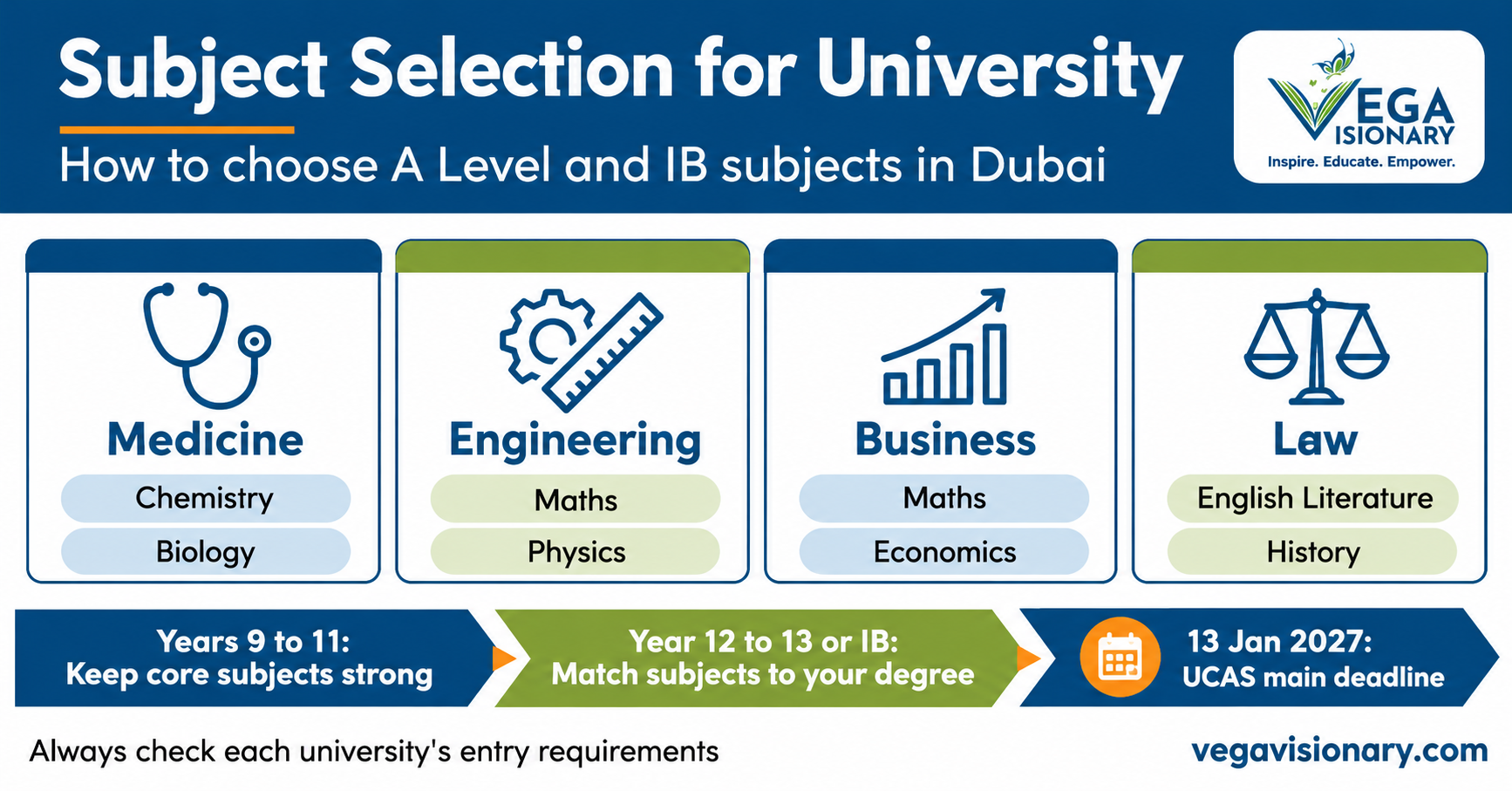
Choosing the right subjects is one of the first big decisions on the road to university, and it often arrives earlier than families expect. In Dubai, where students follow IGCSE, GCSE, A Level and IB pathways, the subjects chosen between ages 14 and 16 can open or close doors to degrees in medicine, engineering, business and law. Getting subject selection for university right means matching what you enjoy, what you are strong at, and what your target courses actually require.
The timing matters right now. Term 2 begins in January, which is when many schools in Dubai start subject-option decisions. The UCAS main deadline for 2027 entry is 13 January 2027 at 18:00 UK time, and the earlier deadline for Oxford, Cambridge, medicine, dentistry and veterinary courses closed on 15 October 2026. Whether you are a Year 11 student choosing A Levels, an IB student deciding between Higher and Standard Level, or a parent trying to understand the system, this guide shows you how to choose A level subjects and IB subjects with a clear plan.
Universities do not look only at grades. They look at whether your subjects prepare you for the course you are applying to. School counsellors across Dubai explain that UK universities want to see depth and achievement in your chosen subject, while US universities look for a broader profile with one clear area of real strength. In the UK, subject-specific supercurriculars such as wider reading, projects and competitions strengthen the case for the subjects you choose.
Some degrees have fixed subject requirements. Medicine usually asks for Chemistry and often Biology, and most engineering degrees expect Mathematics and Physics. Others, such as law, history or business, are more flexible, but that does not mean every combination is equally strong. The Russell Group, which represents 24 leading UK universities, retired its old list of “facilitating subjects” in 2019 and now offers an online tool called Informed Choices, which shows the subjects that are useful for specific degrees.
What Dubai Students Are Choosing
Degree choices are shifting. Data from one of the UAE’s largest school groups shows that business and management was the most popular degree choice among its graduates for the fifth consecutive year, while interest in technology and healthcare keeps rising. More students are also weighing universities inside the UAE, including international branch campuses, alongside the UK, Europe and North America. Whichever route you choose, your subject combination needs to fit the courses on your shortlist.
Key Dates to Keep in Mind
If you are wondering how to choose A level subjects, work backwards from the degree rather than forwards from the easiest option. Use these five steps.
1. Start With a Degree Direction, Not a Single Course
You do not need to know your exact career at 15. You do need a direction, such as health sciences, engineering, business, humanities or creative fields. A direction helps you identify which subjects are essential and which are simply helpful.
2. Check Required and Preferred Subjects
Use the Russell Group Informed Choices tool and the course pages of the universities on your shortlist. Look for the difference between required subjects, which you must take, and preferred or useful subjects, which strengthen your application. Our British Curriculum tutoring team helps students map these requirements across IGCSE, GCSE and A Level pathways.
3. Balance Interest, Strength and Entry Requirements
Students perform best in subjects they enjoy and understand. A subject you are genuinely curious about carries you through two demanding years, and it gives you real material for a personal statement or interview. At the same time, check that your predicted grades in that subject can meet the offers you are aiming for.
4. Keep Options Open When You Are Unsure
If your direction is still unclear, choose a combination that keeps many degrees available. Mathematics, the sciences, English Literature, History, Geography and languages are accepted across a wide range of courses. A mix of one numerate subject and one essay-based subject often keeps doors open for longer.
5. Confirm Everything Directly With Universities
Requirements change between universities and between years. Always check the official course page for the year you are applying and, where possible, contact the admissions office. Informed Choices is a general guide, so it should never replace the university’s own entry requirements.
Instead of chasing every individual degree, it helps to understand the four most common pathways for Dubai students. The table below shows typical subject expectations at UK universities. Always verify the exact requirements for your chosen universities and entry year.
| Degree Pathway | Typical A Level Subjects | Typical IB Diploma Subjects | Worth Checking |
|---|---|---|---|
| Medicine | Chemistry plus Biology, or Chemistry plus another science or Mathematics at some schools | Chemistry and Biology at Higher Level; many schools expect 36 points or more | UCAT requirement, work experience, and whether a second science other than Biology is accepted |
| Engineering | Mathematics and Physics; Further Mathematics valued by some universities | Mathematics Analysis and Approaches and Physics, usually at Higher Level | Chemistry for chemical engineering; Further Mathematics expectations at competitive universities |
| Business, Economics and Finance | No fixed subjects for most business courses; Mathematics, Economics and Business are all useful | Mathematics plus Economics or Business Management | Mathematics requirements for economics, finance and accounting-heavy courses |
| Law | No required subjects; English Literature, History, Politics, Economics or languages work well | Language A, History, Economics or Global Politics at Higher Level | LNAT requirement at some universities; Law A Level is not needed |
Medicine and Healthcare
Chemistry is the most commonly required subject for medicine, and most medical schools also ask for Biology or another science. IB applicants usually need Higher Level Chemistry and Biology, and many UK medical schools expect around 36 IB points or more. Most UK medical schools also require the UCAT, so subject choice, test preparation and work experience should be planned together.
Engineering
General engineering degrees typically expect A Level Mathematics and Physics. Further Mathematics is valued by some universities, and Chemistry may be needed for chemical or materials engineering. In the IB, this usually means Mathematics Analysis and Approaches and Physics, often at Higher Level.
Business, Economics and Finance
Business and management degrees are often flexible about subjects, but economics, finance and accounting-heavy courses commonly look for strong Mathematics. Mathematics, Economics and Business together form a very solid combination for this pathway.
Law
Law does not require a specific A Level, and Law as an A Level is not necessary for a law degree. Universities look for essay writing, critical reading and argument, so subjects such as English Literature, History, Economics, Politics or languages work well. Some universities also ask applicants to sit the LNAT admissions test.
Speak with our expert tutors and receive a personalised subject plan matched to your target degree, your curriculum and your university shortlist.
The IB Diploma asks students to study six subjects, three at Higher Level and three at Standard Level, alongside the core of Theory of Knowledge, the Extended Essay and CAS. The diploma is scored out of 45 points, and universities often ask for specific grades in specific Higher Level subjects as well as a total score. Our IB tutoring programme supports students across all three stages of this decision.
Use Higher Level for Your Degree Direction
Place the subjects your target degree requires at Higher Level, for example Chemistry and Biology for medicine, or Mathematics and Physics for engineering. Check carefully whether a university accepts Standard Level in a required subject, because many do not.
Balance Strengths Across All Six Subjects
A strong total score matters as much as individual grades. Choose subjects where you can realistically score a 6 or 7, and avoid stacking three heavy workloads in the same area if one of them is likely to pull your points down.
Choose Your Mathematics Course Carefully
Mathematics Analysis and Approaches is generally preferred for engineering, physical sciences and economics-focused degrees, while Applications and Interpretation can suit courses with less theoretical content. Check each university’s policy, because some do not accept the Applications route for certain courses.
If you are in Year 10 or Year 11, your A Level options depend on what you study and achieve now. Many A Level courses expect strong IGCSE or GCSE results in related subjects. For a full breakdown of how these qualifications connect, read our guide to GCSE, IGCSE and A Levels.
Protect Your Core Subjects
Mathematics, English and the sciences keep the widest range of A Level and degree options open. Even if your interests lie elsewhere, strong grades in these subjects give you flexibility later.
Check Sixth Form Entry Requirements Early
Many schools set minimum grades for A Level subjects, such as a high grade in IGCSE Mathematics for A Level Mathematics. Ask your school what they expect so you can aim for the right targets before final exams.
Use Term 2 Wisely
Term 2 starts in January and is when many Dubai schools open subject-option conversations. Use this window to research degrees, speak to your counsellor, and test your interest in subjects through reading, short courses or projects.
1. Choosing Subjects Because Friends Chose Them
Your subject combination should fit your goals and strengths, not your friendship group. Universities assess your subjects, not your timetable.
2. Choosing the Easiest Subjects
Subjects that look easier may not meet entry requirements, and they may not give you the depth that competitive universities want to see. Choose subjects that challenge you and that you can realistically excel in.
3. Ignoring the Destination Country
The UK values subject depth, the US values a broader profile with one clear strength, and universities in the UAE, including international branch campuses, have their own requirements. Decide where you may apply before you finalise your subjects.
4. Dropping Mathematics Too Early
Mathematics keeps many STEM, business, economics and social science degrees open. Dropping it without checking your target courses can quietly limit your options later.
5. Leaving the Decision Until the Last Minute
Strong applications take years to build. Starting subject selection for university early gives you time to adjust, build supercurriculars and strengthen your grades.
Subject selection for university is not about finding a perfect answer at 15. It is about choosing a combination that fits your strengths, keeps the right doors open, and meets the requirements of the courses you may want to apply for. Start with a degree direction, check required subjects, use the pathway tables as a guide, and confirm everything with your target universities. With January and Term 2 approaching, now is the right time to begin.
Ready to turn your subject choices into a clear university plan? Visit vegavisionary.com or WhatsApp us on +971 507 943 806 to speak with our academic team.
Written by the Vega Visionary Academic Team
Ideally two to three years before you apply. For most students that means Year 9 or Year 10, when IGCSE or GCSE options are chosen, and again in Year 11 or 12 when A Level or IB subjects are confirmed.
Choose a balanced combination of subjects you enjoy and are strong in, such as one numerate or science subject alongside an essay-based subject. Use the Russell Group Informed Choices tool to see which degrees your combination keeps open, and speak with your school counsellor or a tutor.
Chemistry is required by most UK medical schools, and many also require Biology or accept another science or Mathematics as the second subject. Typical standard offers are around AAA, with some schools asking for at least one A*. Always check each medical school’s published requirements, and plan for the UCAT as well.
Most general engineering degrees expect A Level Mathematics and Physics. Some universities value or require Further Mathematics, and specialisations such as chemical engineering may ask for Chemistry. IB students usually take Mathematics Analysis and Approaches and Physics, often at Higher Level.
No. Most law degrees do not require any specific subject, and universities are more interested in essay writing, critical thinking and argument. Subjects such as English Literature, History, Economics, Politics and languages are strong choices, and some universities also ask applicants to take the LNAT.
For medicine, Higher Level Chemistry and Biology are the most common requirement, and many UK medical schools expect around 36 points or more. For engineering, Higher Level Mathematics Analysis and Approaches and Higher Level Physics are the usual combination. Always confirm the exact grades each university asks for.
Often it is possible in the first weeks of the course, but it depends on your school, timetable and exam board. If you are having doubts, speak to your school as early as possible and get independent guidance so that any change still meets your target university requirements.
The main UCAS deadline for most undergraduate courses is 13 January 2027 at 18:00 UK time. Oxford, Cambridge, medicine, dentistry and veterinary courses had an earlier deadline of 15 October 2026. If you are in Year 10 to Year 12, these dates show why subjects chosen now shape the application you will make later.