Trending Insights

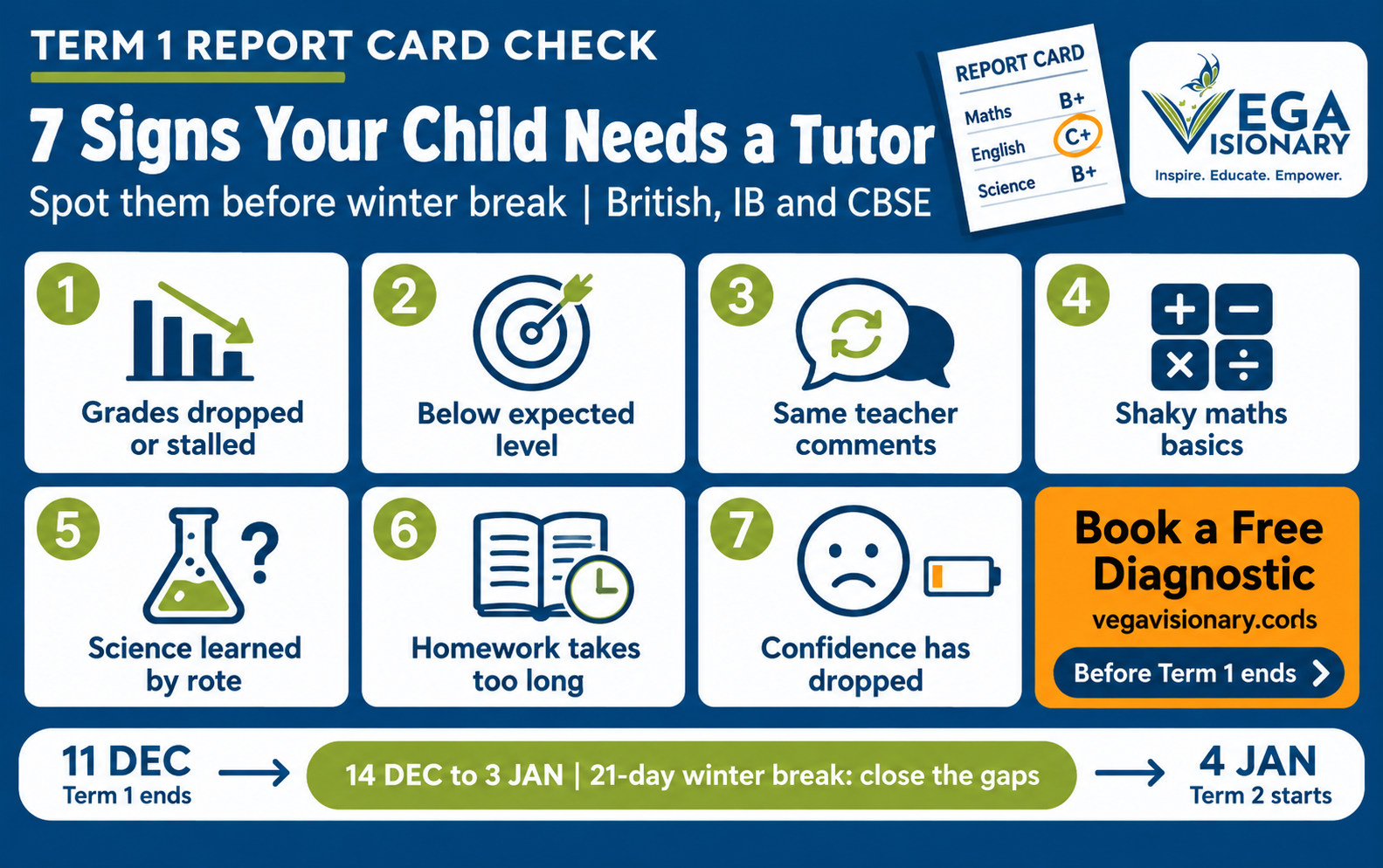
The Term 1 report card is out, or about to land, and many parents in Dubai are reading it with the same question: is this a blip, or is my child quietly falling behind? If you are searching for the signs your child needs a tutor, this guide will help you read the report with a calm, practical eye before winter break begins.
Term 1 ends on 11 December 2026, and the 21-day winter break runs from 14 December to 3 January, with classes resuming on 4 January. That gap is the best window of the year to close learning gaps without the pressure of daily homework and tests. Below are seven clear signs to look for, a quick check you can do tonight, and what to do next.
Report cards and parent-teacher meetings arrive between late November and mid December, which makes them the first real snapshot of how your child is coping with the new year. Term 1 topics are the foundation for everything that follows. A small gap in October, such as shaky fractions or weak paragraph writing, becomes a much bigger wall by Term 2 because new lessons are built directly on top of old ones.
Most parents wait for a bad grade before acting. The earlier signals are quieter: repeated teacher comments, slower homework, a change in attitude. Catching these now costs far less, in time and in confidence, than repairing them in March. The sooner a gap is named, the sooner it can be closed, and online private tutoring during the break lets your child return in January on equal footing with classmates.
You do not need all seven signs to act. Even two or three, showing up together, are a good reason to book a diagnostic and find out what is really going on.
1. Grades have dropped or stalled in two or more subjects
One weaker subject can be a bad week. Two or more subjects slipping, or staying flat while classmates move ahead, usually points to a shared cause such as weak study habits or missing foundations. Compare this report with last year’s final report, not just with the last test.
2. The report shows your child is below expected level
Look past the headline mark. Phrases such as “working towards expectations” or “below target” in British curriculum reports, low criterion levels in IB MYP, or falling marks across CBSE unit tests all tell the same story: your child is not yet securing the core skills the curriculum expects at this stage.
3. Teacher comments keep repeating the same words
Read the comments in every subject and highlight repeats. If you see “careless mistakes”, “needs to revise”, “lacks confidence” or “does not show working” more than once, it is a pattern, not a one-off. Repeated comments are the teacher’s polite way of saying the issue is not going away by itself.
4. Maths foundations are shaky
Maths is cumulative, so gaps compound fast. Warning signs include slow times tables, confusion with fractions and place value in primary, and trouble with ratio, negative numbers or early algebra in secondary. A dedicated maths tutor in Dubai can trace the problem back to the exact topic where understanding broke down and rebuild from there.
5. Science is memorised, not understood
If your child can recite definitions but cannot explain why something happens or apply a concept to a new question, understanding is thin. This shows up as good scores on recall questions and poor scores on application and data questions. Subject-specific science tutors in Dubai can turn memorised facts into real understanding before the harder Term 2 topics begin.
6. Homework takes too long or needs you at the table every night
Watch how long homework takes and how much help it needs. If tasks that should take 20 minutes stretch into an hour, or your child cannot start without you, the difficulty is likely deeper than effort. Independence is the goal of good learning, and a tutor helps your child get there so evenings stop turning into battles.
7. Confidence and attitude have changed
Phrases like “I am just bad at maths”, reluctance to go to school, or avoiding certain subjects are emotional signs of an academic problem. Children rarely say “I have a gap in fractions”. They say “I hate this subject”. Restoring confidence early matters as much as restoring marks.
Experience a free diagnostic session with our expert tutors and receive a personalised winter break plan built around your child’s Term 1 report card. Winter break schedules fill up early, so reach out before Term 1 ends.
Every curriculum reports progress differently, so the same worry can look different on paper. Here is what to check first in each.
Whichever curriculum your child follows, the question is the same: is the report showing steady progress, or is something being carried forward that will cause trouble later?
You do not need to be a teacher to run this check. Sit down with the report, a pen and your child’s recent homework, and work through the steps below.
If this check raises two or more concerns, treat it as a sign to get a professional view. A diagnostic costs nothing and removes the guesswork.
From 14 December to 3 January, there is no new content, no homework deadline and no test to prepare for. That calm is exactly what gap-closing needs. Three weeks of focused, low-pressure sessions can rebuild foundations that are almost impossible to fix in the middle of a busy term, and your child starts Term 2 on 4 January with confidence instead of catching up.
There is also a cost to waiting. Every week a gap stays open, the next topic becomes harder, and children quietly decide that a subject is “not for them”. Many families use the break as a reset because a small step now prevents a much larger problem in March. Dates can differ for schools on an April-start calendar, so always check your own school’s approved calendar.
A good diagnostic is a conversation and a check, not a test your child dreads. At Vega Visionary, the free diagnostic is designed to be simple, friendly and useful, whether your child is in primary, middle school or secondary.
Sessions run live and one-to-one online, so your child learns from home during the break with no travel. Start from our online private tutoring page to see how it works.
Not every tutor is the right fit for every child. Before you commit, check these points.
For maths and science, which cause the most Term 1 worry for parents, look for subject specialists. You can explore our maths tutors in Dubai and science tutors in Dubai for focused support.
A Term 1 report card is not a verdict on your child. It is a map that shows where support will make the biggest difference, and the next few weeks are the best time to use it. Trust the patterns you notice, run the 15-minute check, and use the 21-day winter break to close gaps while the pressure is low.
Ready to start? Visit vegavisionary.com to explore our tutoring programmes, or message us on WhatsApp at +971 507 943 806 to book your child’s free diagnostic.
Written by the Vega Visionary Academic Team.
Look for patterns rather than single events. If grades are slipping in more than one subject, teacher comments repeat, homework takes much longer than it should or your child’s confidence has dropped, extra time alone is unlikely to fix it. A short diagnostic will show whether the issue is a gap, a habit or simply a bad week.
Before winter break is usually best. The 21-day break is free of homework and tests, so your child can rebuild foundations calmly and return to school on 4 January ready for Term 2. Starting in January means learning gaps and new content at the same time, which is harder.
Yes. A tutor can stretch a strong student with harder problems, deeper understanding and early exposure to next term’s topics. Tutoring is not only for children who are struggling. It is also for children who are ready to go further.
It can be very effective when sessions are live, one-to-one and well paced. Younger children do best with shorter, interactive lessons, visual explanations and a tutor who builds a friendly relationship. Parents also save the travel time, which matters during a busy December.
Start with maths, because it builds step by step and gaps spread quickly into other subjects. Then look at science and English. The report card and a diagnostic will show which subject has the widest gap, and that is where the break is best spent.
It depends on the size of the gap, which is why a diagnostic comes first. Many families begin with a few short sessions per week and adjust after the first week. The aim is steady progress while still leaving plenty of time for rest and family plans.
We review your child’s Term 1 report card, check key topics with a curriculum-qualified tutor, identify the exact gaps and share a personalised winter break plan. There is no obligation to continue.
Yes. Vega Visionary supports the British curriculum from KS1 to A-Level, the IB programmes (PYP, MYP and DP) and CBSE, with tutors who teach to your child’s specific syllabus and assessment style.